
List of Works » Orchestral » Piosenki
List of Works » Vocal » Piosenki
Piosenki by DAVID BRUCE
Description
 Poems © Julian Tuwim, used with permission. Also traditional playground chants.
Piosenki is an attempt to reflect the varied and beautiful images of and from childhood, found in the wonderful children's poems of Polish poet Julian Tuwim. Tuwim's poems range from simple 'playground rhymes' like Dwa Michaly and Idzie Grzes through to the poetic sophistry of Dwa Wiatry and Mroz, the very words of which ('Chrest I brzek, zgrzyt I stek') so vividly capture the sound of the crunching, rattling sleigh.
What particularly attracted me was the range of different voices and view-points Tuwim gives us from poem to poem. Some poems, like Ptasie plotki with it's chorus of gossiping and squabbling birds appeal directly to the child's imagination; others, like the rather dour Rok i bieda - which potrays each of the four seasons as a cause of consternation and misery - take on a sensibility which is almost adult. It is interesting to note that in the latter poem, Tuwim carefully keeps the language clean and simple to convey its rather deep message in language a child would fully understand. Overall, I tried to select poems that would reflect this range of Tuwim's rich, complex and unpatronising work.
Alongside seven of Tuwim's poems I have interspersed four playground chants ('wyliczanki' in Polish), including the mean-spirited, name-calling Pani Zosia and rounding off in celebratory fashion with the nonsense rhyme Trumf Trumf.
I used the Polish word piosenki for the title, as it implies popular songs, as opposed to the more serious piesn which implies an art song or lieder.The musical language of Piosenki draws on a wide range of folk influences from all over Eastern Europe, including the music of the Polish gorale (mountaineers), Klezmer music (Tuwim himself was Jewish) and Gypsy music from Romania and Hungary. I have loved all of these varied, but closely related musics for many years and these songs seemed an entirely appropriate place to explore that passion in greater depth.
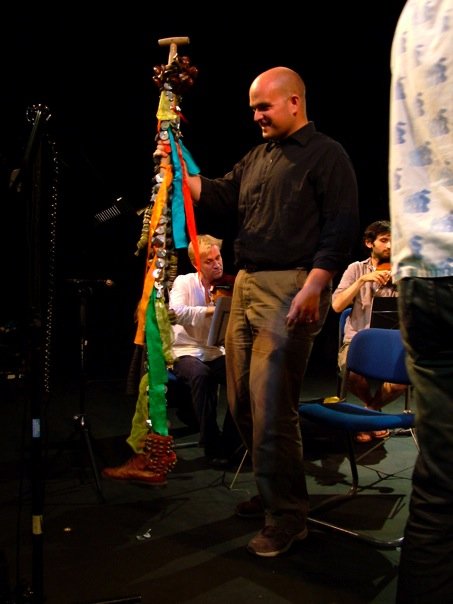
The instrumentation in two of the songs merits special attention - Smierdziel ('Smelly') uses three different instruments to produce similar flatulent effects - the lion's roar, the Brazillian cuica and at the start, a bow hair tied to the violin's G string (I technique I came across used by the Romanian group Taraf de Haidouks). In each instrument the sound is produced by the friction of rubbing the fingers along a string. In the final song, Trumf Trumf, I use a home-made folk instrument found in many countries around the world and called variously, a largerphone, a zobstick or a bushwhacker. I am grateful to Michael Ward-Bergman for introducing me to this instrument and for his guidance in how to build one.
Whilst Piosenki is not directly aimed at children (I hope they might enjoy the piece nonetheless!), my hope is that it presents a varied and truthful image of childhood - sometimes playful, sometimes serious - which, like Tuwim's poems themselves, is not easy to sum up in words.
SUMMARY OF SONGS
- Dwa Michaly (Two Michaels)- two Michaels dancing and spiralling round each other. The words similarly spiral around until the two Michaels collapse on the ground.
- Mroz (Frost)- the peasant boy is riding through the forest on his sleigh with sticks he has gathered. The frost, the sticks and the sleigh all scrape and screech, but as the poem's last line says, together they create a music which makes the load seem lighter and the frost less harsh.
- Pani Zosia (Mrs Zosia - playground chant)- The words mean "Mrs Zosia has a husband who is always drinking"
- Smierdziel (Smelly)- The smelly boy complains about a terrible smell wherever he goes. He marches around complaining "Disgrace! Comrades, stand firm against from the stink!" - the last line says to the boy "Don't protest when it's you who's the smelly one!"
- Siedzi Baba na cmentarzu (Granny in the cemetary - playground chant) , Granny sits in the cemetary and a ghost makes her jump, continuing without a break into:
- Stary Kowal (This Old Cobbler - playground chant) - this old cobbler cobbles, the music continues without a break into:
- Idzie Grzes(Grzes walks along) - A comical rhyme about the hapless Grzes who walks along carrying a bag of sand. He doesn't notice the sand is leaking and is just happy the load is lighter; but when he gets home and finds the bag empty he has to go and get some more - and so on, and so on, and so on.
- Rok i Bieda (The year and misery)- there are four miseries in the world - spring, summer, autumn and winter. Though reluctantly in each case, the poet admits there are some advantages, such as the tasty blueberries growing in the summer forest.
- Dwa Wiatry (Two Winds) - a poetic description of two winds who chase each other around the orchard, before disappearing into the silence.
- Ptasie Plotki (Gossiping birds) - the cockrel came to the turkey and gossipped about the duck's down. The duck came to the guinea-fowl and gossipped about the turkey's beak - and so on, until in the end the whole yard was filled with flying feathers
- Trumf Trumf (Nonsense Chant)
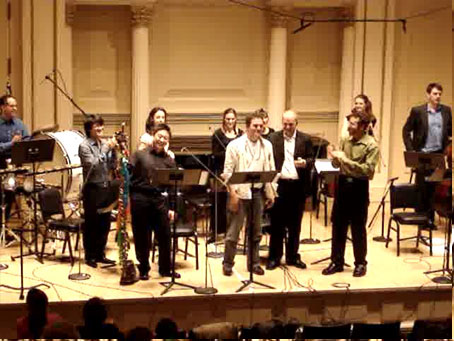
On stage at the Weill Hall, Carnegie Hall with Yang Yang (holding the lagerphone), Kyle Ferrill (who deputized part of the Baritone role), conductor Alan Pierson and just out of shot, Melissa Wegner
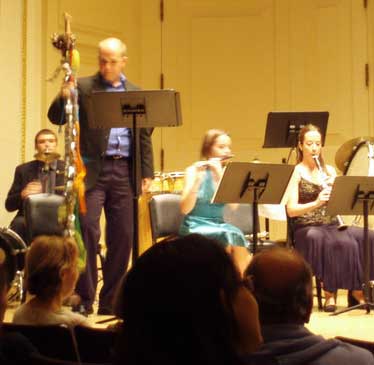
Baritone, Kyle Ferrill playing the lagerphone with Ensemble ACJW in a subsequent performance, also at Weill Hall
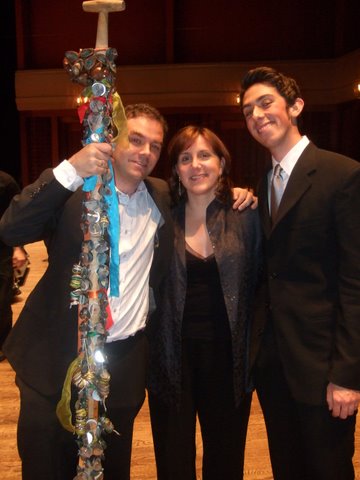
Piosenki has now been taken up by world-famous soprano Dawn Upshaw, who has performed it in Minneapolis and at Carnegie Hall. Here's the latest picture, together with Baritone Evan Hughes and the composer.

And by the UK group Chroma who played it at the Tete a Tete opera festival in Hammersmith:
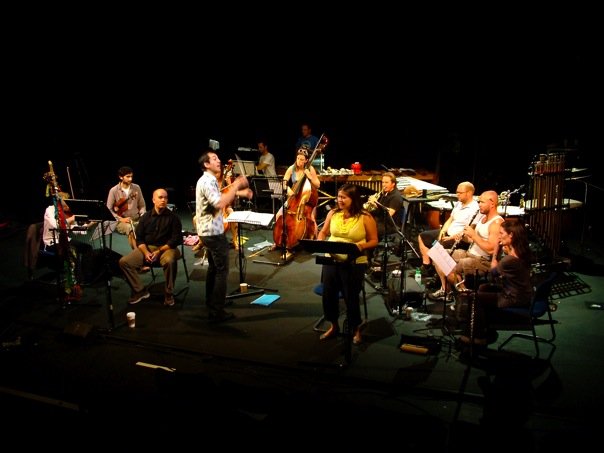
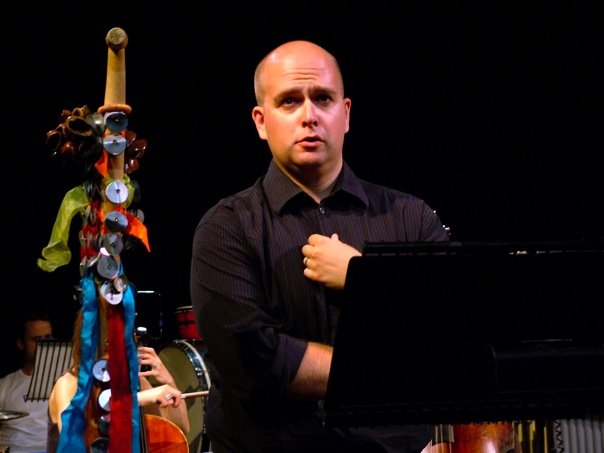
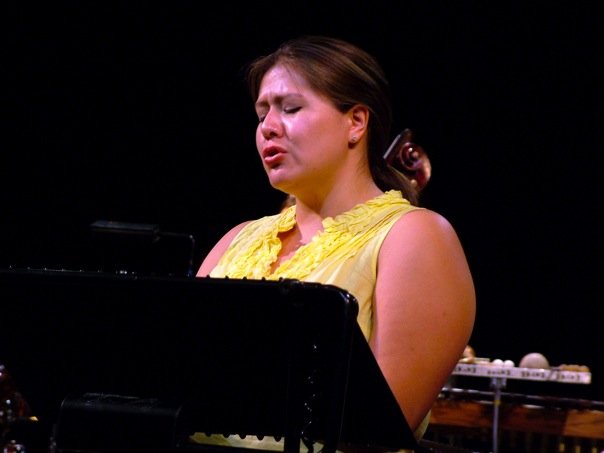
More info on the lagerphone used in Piosenki here
Press / Latest Reviews
|
New York Times / Nov 2008 Vivien Schweitzer
"David Bruce incorporates his lagerphone into the final section of his vivacious song cycle "Piosenki" (in Polish, popular songs), which concluded the program and was its highlight." "Mr. Bruce's lagerphone, a percussion instrument in the shape of a long stick, is covered with bottle tops (hence the "lager") and other metal noisemakers and decorated with colorful streamers. When pounded on the floor, it produces a jingly sound akin to a tambourine's but louder. The rest of the colorful score evokes Polish folk music and Slavic wedding bands with klezmer clarinet tunes, zesty piccolo riffs, syncopated rhythms and energetic fiddling. The audience laughed at the musical flatulence of "Smelly," the fourth verse." |
|
New York Times / Oct 2007 Anthony Tommasini
Last spring the ensemble presented the premiere of Mr. Bruce's "Piosenki" for two singers and large ensemble, a 25-minute setting of seven Polish poems by Julian Tuwim and four Polish playground chants. Clearly the piece was a hit with the fellows, for they played it again here, with Melissa Wegner and Kyle Ferrill as the soprano and baritone soloists. This hypercharged work evokes the textures, colorings and character of Polish folk music, but not, as Mr. Bruce told the audience, actual folk tunes. The songs abound in pummeling rhythms, relentless dance meters, klezmer clarinet tunes, country fiddling, clanking chimes, stretches of clattering din and passages of bittersweet lyricism. Great concert." |
|
Feast of Music Blog / Oct 2007 Feast of Music
"But the best was saved for last. David Bruce's (b. 1970) Piosenki...is a cycle of Polish folk songs and children's poems written by Julian Tuwim and other anonymous sources. The musicians played like a Polka band gone awry, and were accompanied by the remarkable actor-singers Melissa Wegner and Kyle Ferrill - who doubled up late on a strange rattlestick instrument apparently used in Polish festivals. The amusing, often bawdy songs caused belly laughs throughout the recital hall. " |
|
Times Union / Oct 2007 James Hennerty
"Bruce is fascinated by the sounds of eastern European cultures, including gypsy and klezmer music. His writing is masterful, both in setting text to melody, and in orchestrating sound for nine players." |
Details
for Soprano, Baritone and Chamber Ensemble of Nine Players
Orchestral Version for Soprano, Baritone and Orchestra
Soprano
Baritone
1 Flute (doubling piccolo and alto flute
1 Clarinet (doubling Bass clarinet)
1 French Horn
1 trumpet
1 Percussion
1 Violin
1 Viola
1 Cello
1 Bass
Orchestral Version: 2 1 2 1 - 2 2 2 1- perc(2) - strings
Duration 23mins
Composed 2006
First performance Weill Recital Hall, Carnegie Hall, New York, April 15th 2007
Commissioned by Carnegie Hall

Past Performances
- Apr 14 2007
Weill Hall, Carnegie Hall (Melissa Wegner, Kyle Ferrill, Carnegie Hall Workshop Ensemble) (world premiere)
- Oct 5 2007
Skidmore College, Saratoga Springs (Ensemble ACJW)
- Oct 11 2007
Weill Recital Hall, Carnegie Hall (Ensemble ACJW)
- May 28 2008
Meet the Composer Gala, Manhattan Penthouse NY (Metropolis Ensemble) (extracts)
- Oct 17 2008
Ordway Center,St Paul, Minnesota (Dawn Upshaw, St Paul Chamber Orchestra)
- Oct 18 2008
Ordway Center,St Paul, Minnesota (Dawn Upshaw, St Paul Chamber Orchestra)
- Nov 2 2008
Zankel Hall,Carnegie Hall (Dawn Upshaw, Ensemble ACJW)
- Aug 9 2009
Tete a Tete Festival, Hammersmith, London (Chroma) (uk premiere)
- Jun 9 2011
Ojai Festival (Dawn Upshaw's 'Voices: The Next Generation') (extracts)
Related Posts
• The townships of my mind (9/16/2013)• Piosenki at Ojai (6/5/2011)
• Freshly polished Gumboots (8/20/2009)
• Chroma / Piosenki video (8/14/2009)
• Chroma / Piosenki pictures (8/10/2009)
• Piosenki (8/3/2009)
• Piosenki in Hammersmith Aug 9 (8/3/2009)
• UK premiere of Piosenki (7/1/2009)
• Gumboots Interview (3/3/2009)
• Groanbox (12/6/2008)
• Shake rattle and stomp (11/3/2008)
• Dawn again (10/27/2008)
• Dawn, Evan and Boot (10/19/2008)
• Polish Dawn (9/30/2008)
• Lagerphones and laments (7/22/2008)
• Meet the Composer Gala (5/7/2008)
• Birds and Dates (2/27/2008)
• Bird Talk (10/17/2007)
• Piosenki in New York (9/28/2007)
• All going on (9/6/2007)
• Further performances of Piosenki (7/13/2007)
• From the other side... (4/17/2007)
• Carnegie Hall premiere (3/30/2007)
• Tuwim in New York (2/22/2007)
• New piece (2/1/2007)
• Violin effect : pulling a tied bow hair (1/19/2007)
• My Lagerphone is built (1/19/2007)
COMMENTS
Leave a Reply