
Share the love
Posted on Tuesday, August 3, 2010
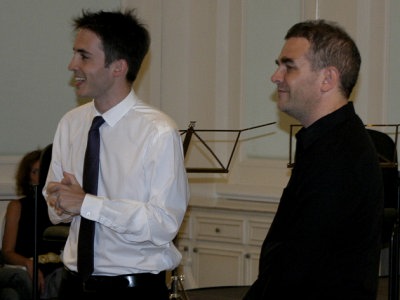
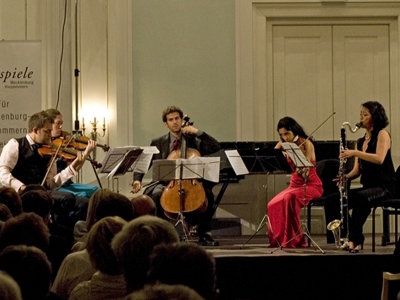
I'm just back from performances of Gumboots at the tongue-twisterly named Mecklenberg-Vorpommern festival in and around Heiligendamm, northern Germany. It's the first time I've spoken before a piece to an audience that didn't speak my language (though of course lots of them probably did). It kind of doubles the mystery of what that 'collective mind' is thinking. ACJW oboist James Austin Smith was on hand to translate:
It's so exciting to hear a piece in so many different settings and environments as Gumboots has been played. It's not just the different acoustics and the effect that has on the piece, it also helps to form an image in my mind of the wider 'setting' for writing a piece of classical music. The world a piece could, if it's lucky, finally inhabit (something you don't really get when the piece is only performed once!).
For me it feeds back in a very useful way into my musical imagination. Part of my actual process of composing is trying to sense the interaction the music will have, the connection it will make. The default position you usually hear composers say is that "it's impossible to write to please an audience - how can you, who are they?" and I don't think I'm writing to please anyone (except myself), but I do think it's possible - actually, essential - to try to find a connection of some kind, that on the whole speaks to people.
[update - Kyle Gann has a very nice post about this very subject and in the comments section he describes the artists role as an attempt to 'make deep contact' with other human beings, which I like a lot]
I go through a myriad of ways of trying to accurately guage this when I'm writing - singing it out in my head, bashing it through on the piano, playing individual lines if I have the instrument, and listening 'through' the computerized squeaks and squawks from Sibelius - how would such an effect 'speak' in performance. It requires an intense kind of focus and concentration. And after that, of course, there is the judging and reevaluating how successful it's all been during the actual performance. At the end of the day I don't think it's about pandering to anyone, it's about making something that speaks as directly and clearly as possible. But it is also acknowledging the fact that a piece of music requires an audience. Forgive me if I again quote the British sculptor Anthony Gormley:
"I felt the romantic view of the artist as someone standing apart from and remaking the world, was no longer tenable. It was a betrayal of what art could do. Art is nothing without being experienced and shared. And I wanted to start again on that basis"
How lucky I am that I've been able to experience and share this piece now with so many different audiences!
COMMENTS
Archive
2024: Jan Feb Mar Apr May Jun Jul Aug Sep Oct Nov Dec
2023: Jan Feb Mar Apr May Jun Jul Aug Sep Oct Nov Dec
2022: Jan Feb Mar Apr May Jun Jul Aug Sep Oct Nov Dec
2021: Jan Feb Mar Apr May Jun Jul Aug Sep Oct Nov Dec
2020: Jan Feb Mar Apr May Jun Jul Aug Sep Oct Nov Dec
2019: Jan Feb Mar Apr May Jun Jul Aug Sep Oct Nov Dec
2018: Jan Feb Mar Apr May Jun Jul Aug Sep Oct Nov Dec
2017: Jan Feb Mar Apr May Jun Jul Aug Sep Oct Nov Dec
2016: Jan Feb Mar Apr May Jun Jul Aug Sep Oct Nov Dec
2015: Jan Feb Mar Apr May Jun Jul Aug Sep Oct Nov Dec
2014: Jan Feb Mar Apr May Jun Jul Aug Sep Oct Nov Dec
2013: Jan Feb Mar Apr May Jun Jul Aug Sep Oct Nov Dec
2012: Jan Feb Mar Apr May Jun Jul Aug Sep Oct Nov Dec
2011: Jan Feb Mar Apr May Jun Jul Aug Sep Oct Nov Dec
2010: Jan Feb Mar Apr May Jun Jul Aug Sep Oct Nov Dec
2009: Jan Feb Mar Apr May Jun Jul Aug Sep Oct Nov Dec
2008: Jan Feb Mar Apr May Jun Jul Aug Sep Oct Nov Dec
2007: Jan Feb Mar Apr May Jun Jul Aug Sep Oct Nov Dec
2006: Jan Feb Mar Apr May Jun Jul Aug Sep Oct Nov Dec